
By Jim Ferri
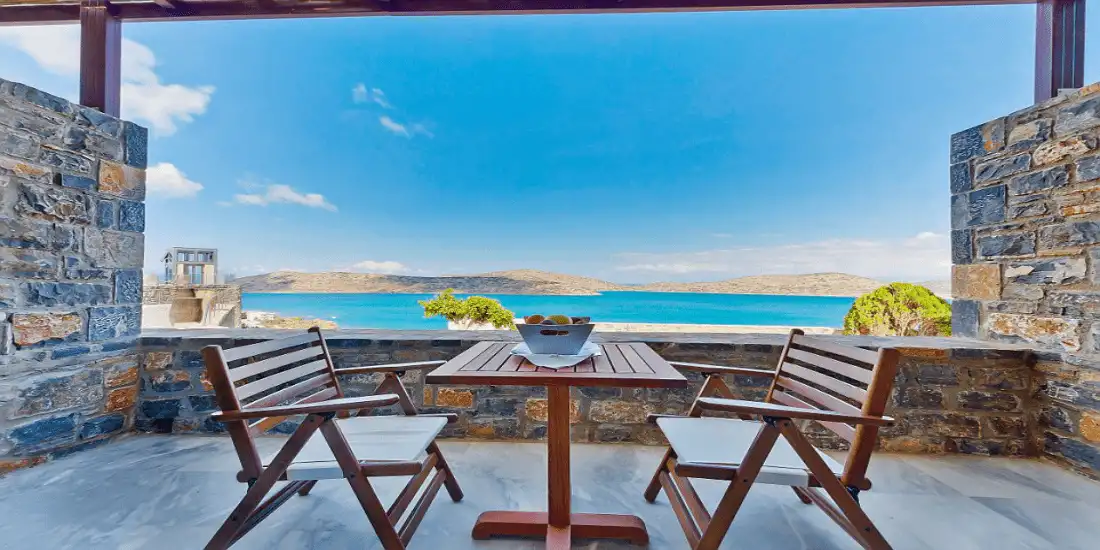
Few places on earth are as seductive as the Greek islands.
They are unique, magical places, sun-baked bits of paradise strewn across an azure sea, where little sugar-cube villages crowd harbors and hillsides and blazing bougainvillea tumbles over whitewashed walls that seem to meander forever. In the early morning and evening, I find the soft light that flows in from the sea almost ethereal.
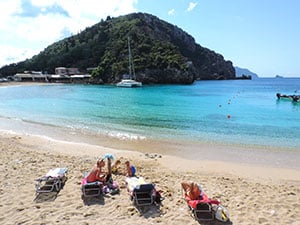
The beach at Palaiokastrítsa, Corfu
It’s an intoxicating mix that leaves me craving for more, and every few years I get the urge to return for another fix.
There are about 6,000 islands scattered around Greece, although only a bit more than 200 of them are inhabited. Still, though, they cover quite a bit of nautical real estate in the Ionian Sea on the Italian side and the Aegean on the Turkish.
While many travelers have their favorite Greek island, I have four. Each is special and provides a unique experience.
SANTORINI
Santorini is the queen of the Cyclades Islands southeast of the mainland. Few ever forget it, so captivating is its natural beauty, and it’s a must-see port on many cruises.
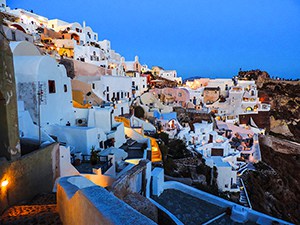
Oia on Santorini at dusk
Called Thira by the Greeks, it’s a near-magical island of picturesque white villages clinging to towering cliffs, fascinating archeological sites, and multicolored beaches lapped by a cobalt-colored sea. It’s greatest draw, though, is that it gives you a front-row seat for the most spectacular sunset you’ll see anywhere.
Many people only visit the town of Santorini, but there are other spectacular sights about the island. Well worth visiting is Akrotiri – Santorini’s little Pompeii – a 3,500-year-old Minoan outpost buried under ash during the volcanic explosion that created the island that exists today.
Thankfully, an air-conditioned complex was built over the entire site allowing you to walk the streets of the small village (where some houses are three stories high) in total comfort. It’s an incredibly interesting place.
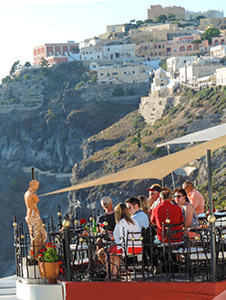
A café on Santorina
Also, spend an afternoon wandering up and down the narrow lanes of Pyrgos, the little hillside town in the center of the island wrapped around the ruins of Kasteli Castle. The small town has numerous shops and restaurants, as well as an incredible 46 churches.
While many people watch the sunset from the cliff-top cafés of Santorini, a much better place is in the town of Oia (pronounced “ee-a”). On the western end of the island, it’s a quintessential Cyclades town with many of the whitewashed houses trimmed in blue, and bougainvillea and bright red geraniums cascade everywhere.
CORFU
Most people don’t visit Corfu for the beaches, but for the mellow melding of British, French and Italian influences so evident on this small Ionian island off Greece’s northwest coast.
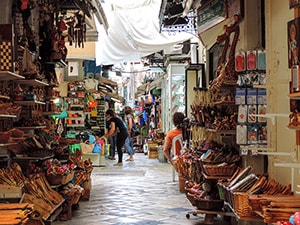
A market in Corfu Town
As soon as you arrive in Corfu Town, the island’s little cosmopolitan capital, you immediately notice the Italianate architecture, the result of 400 years of Venetian occupation. Wander further towards the old British cricket field and you’ll find cafes and shops in French-built colonnaded buildings that provide more than a nuance of Paris’s Rue de Rivoli.
If you’re not on a tour, it’s worthwhile renting a car to explore the island. Head southward down the coast about a half hour to the beautiful and popular Achílleion Palace, built for Empress Elizabeth of Austria in 1890. It became better known less than 100 years later as the set for the casino scenes in the James Bond film For You Eyes Only.
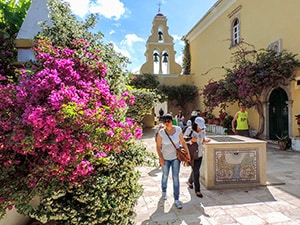
The monastery of Moní Theotókou at Palaiokastrítsa
Another alternative is to drive north to Palaiokastrítsa, a popular resort area on the island’s west coast. Since the island is so small, it’s a relatively short drive of only about 10 miles.
Be sure to visit the 17th-century monastery of Moní Theotókou, a beautiful place, where there’s a carving of The Tree of Life on the church ceiling. Its quirky little museum contains everything from ancient religious icons to a giant clamshell.
On your return to Corfu Town take the serpentine road up through the mountains through the ancient olive groves to Lakones and other little villages, enjoying spectacular views of the coast along the way.
MYKONOS
Another gem of the Cyclades is picture-perfect Mykonos.
A wonderful place to while away an hour, a day, or a week, it’s one of the glitziest of the Greek islands, with a jet-set reputation earned decades ago. It was that reputation, in fact, that kept me away from it for many years. But when I finally succumbed and visited not long ago, I fell in love with it.
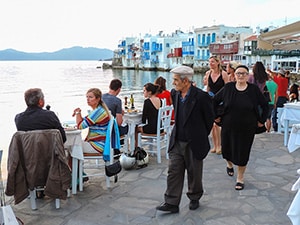
Little Venice in Mykonos Town
The fact is that Mykonos is big enough that you can find both glitz and solitude. I found the latter by simply booking a hotel room in the main city of Mykonos Town, known as Chora to the locals, which allowed me to leisurely explore the old Town for a couple of days.
More than, anything I greatly enjoyed just wandering about Mykonos Town’s narrow alleys that bisect a jumble of whitewashed houses and shops. Narrow and winding, as they are on so many of these islands, they were designed to protect inhabitants both from the winds and pirate raids.
One of the most popular places in Mykonos Town is a sliver of seaside land known as “Little Venice.” It’s a clutch of brightly painted buildings whose balconies jut out over the sea and provide a colorful backdrop to the many bars, cafes, and restaurants that line the shoreline between it and the town’s famous 16th-century windmills. It’s a great place to relax in a little cafe and watch the sun run through its pallet of pastels in the evening.
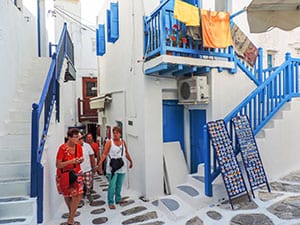
Shoppers in Mykonos Town
On the other side of the port is the Archaeological Museum, set in a Neo-Classical building. In addition to being a great place to escape the midday heat, it’s an interesting place with a collection of 6th-7th century BC ceramics and Roman and Hellenistic carvings, as well as artifacts from Delos, one of the most important archeological sites in the country.
Also, wander around the minuscule harbor – which, like Little Venice, seems to be a hub of constant tourist activity – and through the souk-like warren of streets containing innumerable shops.
RHODES
Rhodes, within sight of the coast of southern Turkey, is the capital of the 12-island Dodecanese chain. Although it’s popular as a holiday destination with Europeans, many American travelers never get to the island unless they’re on a cruise.
It’s an intriguing place, however, the most medieval of the Greek islands, and it’s well worth a few days to explore.
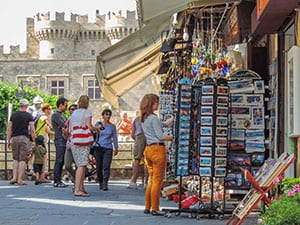
The old city of Rhodea
Rhodes, the island’s main city, is a Byzantine time capsule, that was conquered by the Knights of Saint John of Jerusalem who turned it into a thriving Medieval city before it was seized by the Ottoman Turks 200 years later.
It’s amazing how unspoiled the city’s interior remains. The Street of the Knights is one of the best-preserved Medieval streets in Europe, and that aura remains so strong, you half-expect a knight on horseback to come trotting across the cobblestones at any moment.
The old city’s warren of streets and narrow alleys, all lined with medieval buildings, minarets, old houses, tranquil little squares and fountains, transport you back to other eras. Rarely do you find 24 centuries of history condensed into such a relatively small area.
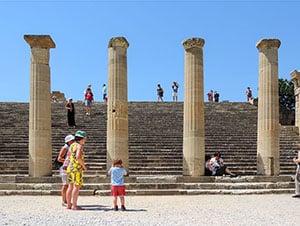
The Acropolis at Lindos
Rhodes is also a place where you should get a rental car to explore the island since taxis charge a flat rate to different towns on the island. It can be quite a savings. A trip by taxi from Rhodes to the quaint town of Lindos is over $200 for the round-trip; I arranged for a rental car at my hotel for a flat rate of $35 for the day.
Drive your rental to the little town of Lindos, once a powerful and wealthy village. It remains a maze of narrow lanes, some only a few feet wide, all heading uphill towards the ancient fortress 380 feet above the sea. Walking through the streets in the bright sun, past shops where brilliantly colored clothing hung on the white walls, I sometimes felt as if I was walking through a rainbow.
Be sure to go up to the Acropolis (either by burro or foot) where you’ll find the view out across the sun-speckled Mediterranean well-worth the effort.
IF YOU GO:
Greek National Tourism Organization
305 East 47th Street
New York, NY 10017
Tel: (212) 421-5777
info@greektourism.com
www.greektourism.com
Leave A Comment
You must be logged in to post a comment.